“I need to ask you for one favor.”
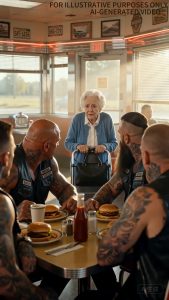
The laughter at the biker table stopped so suddenly that the whole diner seemed to notice. A moment earlier, four big men in black leather vests had been joking over coffee, fries. Their voices had filled the corner booth with the rough, easy noise of men who looked like they had seen every kind of trouble.
Then the small voice beside them broke through it all.
Four heads turned.
An elderly woman stood next to their table, both hands wrapped tightly around the handles of a silver walker. Her hair was white and neatly combed, her shoulders narrow under a faded blue cardigan. A black purse hung from her wrist, worn at the corners, the kind of purse that looked as if it carried medicine, grocery coupons, old photographs, and the last pieces of a careful life. Her gentle eyes were wet, but she was trying hard not to cry.
The youngest biker still had a burger lifted halfway to his mouth. He lowered it slowly.
“Ma’am,” he said, confused but respectful. “What?”
The woman swallowed. Her fingers tightened around the walker until her knuckles looked pale.
“Would you boys pretend to be my sons for one afternoon?”
The diner fell into a silence complete it felt unreal. At the counter, a waitress froze with a coffee pot tilted above a mug. A trucker lowered his newspaper just enough to stare. A couple near the window stopped cutting into their pancakes. Even the old jukebox in the corner, suddenly sounded too loud.
The bikers looked at one another, uncertain whether they had heard her correctly. They were large men, heavy-shouldered, tattooed, and weathered, the kind of men strangers often judged. But the woman was looking at them not with fear, not with suspicion, but with desperate hope.
The biggest biker, a bald man with a scar crossing one eyebrow, leaned forward.
“Why would you need us to do that?” he asked quietly.
The old woman drew a shaky breath. She tried to stand a little straighter, as if dignity was the last thing she still had full control over.
“My name is Ruth Miller,” she said. “I live three miles from here, in the little blue house by the creek. My husband, Daniel, built that house with his own hands before he died.”
Her voice trembled.
“He cut the beams himself. He laid the porch. He planted the two maple trees in the front yard because I told him I wanted shade in the summer. We raised our children there. We buried our dog under the lilacs. Every Christmas, every birthday, every ordinary morning of my life is inside those walls.”
No one in the diner moved.
Ruth blinked fast, but the tears came anyway.
“Now a real estate company says I signed papers selling it,” she continued. “They say I agreed to leave. But I did not sign anything. I never sold my home. I don’t even understand half the papers they show me.”
The scarred biker’s face hardened.
“They’re coming today?”
Ruth nodded.
“This afternoon. They said if I am not gone, they will remove my things. They spoke to me like I was already invisible.” She looked down at the floor. “I have no family close by anymore. My sons moved away years ago. One passed, and the other… well, we haven’t spoken in a long time. Those men think I am helpless because I am old. They think I am alone.”
The biggest biker slowly set down his coffee cup. The sound of porcelain against the table seemed to echo.
“They think you’re alone?” he asked.
Ruth nodded, ashamed of a loneliness she had not chosen.
“They think I’m helpless and alone.”
For a second, nobody breathed.
Then his chair scraped hard against the floor as he stood. He was so tall Ruth had to tilt her head back to see his face, but his voice was gentler than anyone expected.
“You’re not helpless.”
Another biker stood beside him, his long beard brushing the front of his vest.
“And you’re not alone.”
The youngest biker wiped his hands on a napkin and pushed his plate away.
“What time are they coming, Miss Ruth?”
Ruth stared at them as if kindness had surprised her more than cruelty ever could.
“Two o’clock,” she whispered.
The fourth biker reached into his pocket, dropped cash on the table for the meal, and looked toward the door.
“Then we’d better go meet your visitors.”
The waitress finally lowered the coffee pot. The trucker folded his newspaper. Somewhere in that diner, the air changed. People who had been watching out of curiosity now watched with something closer to respect.
Outside, four motorcycles waited in the sun, chrome shining, engines cold. Ruth moved slowly, and not one of the bikers rushed her. The biggest man walked beside her walker. Another opened the diner door and held it wide. The youngest carried her purse as carefully as if it were made of glass.
When they reached the little blue house by the creek, the place looked exactly as Ruth had described it. The paint was faded but clean. Two old maple trees shaded the front yard. A porch sagged slightly at one corner, but it looked loved, not neglected. Clay flowerpots lined the steps. Wind chimes moved softly in the breeze.
Ruth stopped at the gate and touched it with one hand.
“Daniel built this, too,” she said.
The scarred biker looked at the house, then at the woman beside him.
“No one should be bullied out of a life like this.”
At two o’clock sharp, a black SUV rolled up the gravel driveway, followed by a white van. Three men stepped out wearing pressed shirts and hard faces. One carried a clipboard. Another held a phone, recording. The third glanced at the motorcycles.
The man with the clipboard approached the porch.
“Mrs. Miller, we are here to complete the property transfer. You were instructed to vacate.”
Before Ruth could answer, the four bikers stepped forward. They did not shout. They did not threaten. They simply stood beside her, steady and immovable.
The bald biker spoke first.
“She says she didn’t sell.”
The clipboard man frowned.
“And you are?”
Ruth lifted her chin. Her voice shook, but it did not break.
“These are my sons.”
The youngest biker folded his arms.
“And we’d like to see every document you claim she signed.”
The men exchanged glances. The confidence they had brought with them began to crack. Bullies often count on silence. They count on confusion. Most of all, they count on people facing them alone.
That afternoon, Ruth Miller was not alone.
Her story was no longer only about a house. It was about the way decent people can appear in the most unexpected forms. Sometimes help comes wearing a suit. Sometimes it comes wearing leather, riding motorcycles, and carrying a stranger’s purse with tenderness. And sometimes the family you need is not the family you were born with, but the people who decide, in one important moment, to stand beside you anyway.