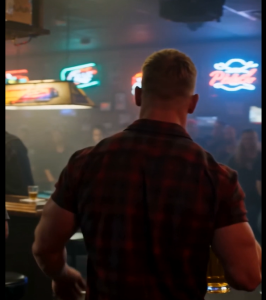
At Mulligan’s, people knew better than to ask questions unless they were ready for trouble. The dive bar sat at the edge of town between a closed hardware store and a tire shop with a crooked sign. Inside, the lights were low, the walls were dark wood, and old neon signs buzzed above faded beer posters. A pool table stood in the back under a green lamp.
That Friday night, the room was crowded and restless. A woman in a green sweater stood near the jukebox with two friends. Several men gathered around the pool table. The bartender wiped glasses with the tired patience of someone who had watched too many foolish men mistake noise for importance. At the far end sat an older man in a blue denim jacket over a gray shirt. His short salt-and-pepper hair, mustache, and stubble gave him a rugged, weathered look, like a man who had spent most of his life where comfort was never guaranteed.
He had ordered one drink and barely touched it. He sat straight, hands near the glass, eyes lowered. He did not bother anyone. That should have been enough. In a decent room, it would have been. But Mulligan’s had a way of turning insecurity into entertainment, especially when someone loud decided that silence looked like weakness.
The loudest man there was Tyler Briggs, a muscular younger patron with short blond hair, a beard, and a red-and-black plaid flannel shirt hanging open over a black T-shirt. Tyler carried himself like a man who needed an audience to feel strong. Then, with a glass pitcher of beer in his hand, he noticed the older man sitting alone.
Tyler smirked first. Then he said something to the men beside him, too low for the older man to hear. They turned, saw the denim jacket, the gray shirt, and the quiet posture, and began to grin. Most kept watching. In places like that, a person could become a target simply by appearing unwilling to fight back.
Tyler walked toward him slowly, making sure everyone saw him coming. The pitcher dangled from his right hand. The older man did not turn around. He kept looking at the counter, calm as stone.
Tyler stopped behind him and leaned over the bar. An empty glass sat beside the older man’s drink. Tyler lifted the pitcher as if he meant to fill it. Then he tilted the pitcher away from the glass and poured the beer directly onto the polished wooden counter.
The liquid spread fast, foaming over the surface, running around the empty glass, and sliding toward the older man’s sleeve. It splashed loudly in the sudden hush.
The older man moved only enough to keep the beer from soaking his cuff. He did not jump back. He did not curse. He did not even look angry. His stillness made the act seem uglier, because everyone could see it was meant to humiliate him. It was not an accident. It was not a joke. It was a challenge thrown at a man who had asked for nothing.
Tyler looked down at the mess with a pleased, malicious smirk. He wanted a reaction. He wanted the old man to complain, tremble, look embarrassed, and give him an excuse to keep pushing. When nothing happened, Tyler turned toward the crowd.
They did. Laughter broke out near the pool table, sharp and careless. One man pointed at the spilled beer. The woman in the green sweater covered her mouth, but she was laughing too. Someone muttered, “Look at him.” Another voice said, “Grandpa picked the wrong stool.” The bartender stopped wiping his glass, jaw tight, but said nothing.
Tyler planted one hand on the counter near the spill and bent closer. The smell of beer rose between them. “We don’t serve bums here, grandpa,” he said.
The words landed harder than the spilled drink. They carried the familiar cruelty people use when they believe age, worn clothes, or quiet dignity make someone less worthy of respect. Around them, the laughter swelled again.
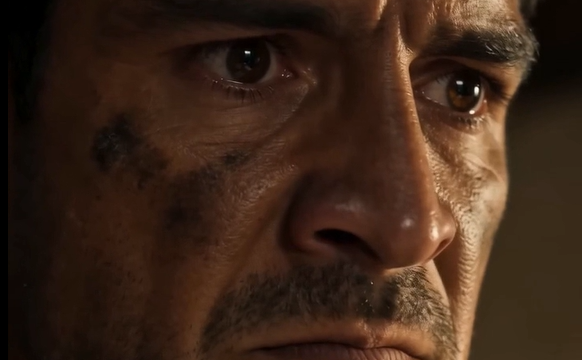
For the first time, the older man slowly turned his head. It was not dramatic. He did not spin around. He did not pound the counter. He simply shifted enough for Tyler to see his profile: the firm jaw, the deep lines around his eyes, and the kind of calm that did not come from fear. It came from experience.
The laughter began to thin.
Tyler’s smirk held for one more second, but something in his face changed. The older man’s eyes were not weak or confused. They were clear, steady, and unblinking. He looked at Tyler as if measuring him, not with anger, but with patience, the way a man watches a storm cloud and knows how close the lightning is.
The bar seemed to shrink around them. The neon buzz sounded louder. A low, tense silence replaced the jokes. Even the men by the pool table stopped moving.
Tyler leaned in again, trying to recover the moment. His shoulders squared. His jaw tightened. He wanted everyone to see he was still in control. But the old man had not raised his voice, and somehow that made him more imposing than if he had shouted.
Then the older man spoke.
“That’s once.”
Only two words. Quiet. Flat. Almost gentle. But they moved through the room like a door locking.
Nobody laughed. The bartender lowered the glass in his hand. The woman in the green sweater stopped smiling. Tyler stared at the older man, caught between insult and uncertainty. He had expected shame. He had expected fear. He had expected an easy victory over a stranger he thought looked poor, tired, and alone.
Instead, he had found a line.
The older man turned his gaze fully toward him, and there was nothing theatrical about it. No threat needed explaining. No past had to be announced. Whatever he had lived through, whatever battles had carved that stillness into him, it was there in his eyes. He was not asking Tyler to understand. He was warning him that respect still mattered, even in a room that had forgotten it.
Around the bar, people looked down at the counter instead of at one another. The spilled beer kept dripping onto the floor, each drop sounding louder than it should have. Tyler’s fingers pressed against the wet wood. For the first time all night, he seemed to realize that strength was not the same as courage, and cruelty was not the same as power.
For older readers, the moment carried a familiar truth: dignity is often quiet, and the loudest person in the room is not always the strongest. Sometimes a lifetime of hardship teaches a man to wait, listen, and answer only when the line has been crossed, clearly for everyone to hear and remember.
The older man did not move from his stool. He did not chase applause, demand an apology, or explain who he was. He simply sat there, composed and immovable, with that single warning hanging in the smoky air.
And every person in Mulligan’s understood the same thing at once: the man they had laughed at was not the one who should be afraid.