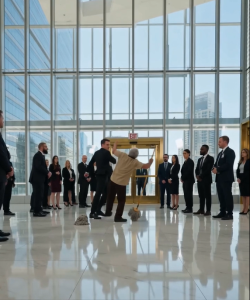
The Harrington Grand Center stood in the busiest part of downtown, a glass-and-marble building designed to make people feel small the moment they walked inside. Employees moved quickly with folders, phones, and coffee, because an important private exhibition was about to open.
Executives, donors, press guests, and selected clients were expected before noon. The company wanted everything perfect. The entryway had to tell every visitor that this was a place of wealth, power, and control.
Near the front doors, an older janitor guided a mop across a small wet mark on the floor. He had gray hair, a calm face, and a beige utility jumpsuit that made him nearly invisible in a room full of dark suits. He simply worked with patient care, making sure no guest would slip and no employee would be embarrassed by a careless stain.
Then the elevator doors opened.
A corporate executive stepped out in a sharp black suit, white dress shirt, patterned tie, and white pocket square. His dark hair was perfectly styled, and his face already carried the look of a man who believed everyone else existed to clear a path for him.
“Why is this area still being cleaned?” he snapped. “We have guests coming.”
The janitor looked up gently. “Almost finished, sir. Just a moment.”
He gave a cold little laugh and stepped closer, as if the older man were nothing more than furniture blocking the hallway.
“Move,” he said.
The janitor shifted the mop aside and tried to give him room. But the executive did not slow down. He shoved past him with his shoulder and hand. The older man lost his balance. The mop slipped across the polished marble. A harsh scraping sound cut through the lobby, followed by the heavy thud of the janitor hitting the floor.
For a moment, nobody moved.
The receptionist froze behind her desk. Two assistants lowered their folders.
The janitor lay on the floor, one hand pressed against the marble, the mop beside him. He did not shout. He did not curse. He only breathed slowly and tried to steady himself.
The executive stood over him, not ashamed, not sorry, but angry that the scene had drawn attention.
“Stay out of my way!” he shouted, pointing down at the fallen man. “Know your place! You’re just staff, act like it!”
His voice echoed through the lobby. The cruelty was not only in the words, but in the ease with which he said them. A person doing honest work was someone he could push aside.
The janitor lifted his eyes. There was no fear in them. There was no hate either. Only disappointment.
A woman near the reception desk covered her mouth. Someone whispered, “That was awful.” Still, no one interrupted the executive.
The executive adjusted his suit jacket and muttered, “Get this mess cleaned up before the real guests arrive.”
Then the main glass doors opened.
Two bodyguards entered first, scanning the lobby. Behind them came a distinguished man in a dark suit and red tie. He moved with quiet authority, the kind that made employees straighten without being told.
The arrogant executive turned quickly. His face changed into a polished, professional smile. He stepped forward, ready to greet the VIP and pretend the ugly scene on the floor had never happened.
But the man in the red tie did not look at him.
He looked past him.
His eyes landed on the older janitor still gathering himself on the marble, and his expression shifted from formal to alarm.
“Sir!” the VIP said, rushing forward.
The lobby watched in stunned silence as the important visitor moved around the executive, bent down, and helped the older janitor to his feet with both hands. One bodyguard picked up the fallen mop. Another stood close by, protective and alert.
The VIP held the older man’s arm with sincere respect.
“Sir,” he said clearly, loud enough for everyone to hear, “thank you for funding this entire exhibition.”
The words struck the lobby harder than the fall had.
The receptionist’s eyes widened. The assistants exchanged stunned looks. The security guard stood straighter, suddenly realizing he had nearly failed to protect Everyone understood at once that the man in the beige jumpsuit was not merely a janitor. He was the reason the exhibition existed.
The older man brushed dust from his sleeve, looked at the VIP, and nodded. “Thank you. I’m all right.”
Then he turned toward the arrogant executive.
No one spoke.
The executive’s face went pale. His mouth opened, but no command came out. Now he stood before the very man whose generosity had funded the event his company was desperate to celebrate.
“I…” the executive stammered. “I didn’t mean that…”
But everyone knew he had meant it. He meant it when he pushed. He meant it when he pointed. He meant it when he called the man “just staff,” not realizing the whole lobby was seeing the truth about him.
The older man studied him for a long moment. When he spoke, his voice was calm.
“A man’s character is clearest when he thinks no one important is watching.”
The VIP turned to the staff. “Please make sure Mr. Whitaker is treated with the respect he deserves.”
The name moved through the room in whispers. Mr. Whitaker. Some recognized it from the donor list. The executive recognized it too, because panic spread across his face.
He had not shoved an invisible worker. He had insulted the key funder.
Mr. Whitaker did not raise his voice or demand revenge. The silence had already done the work. Every employee, guard, and witness had seen what happened.
For older Americans especially, it is a reminder earned through years of working, sacrificing, and watching human nature reveal itself: real class is never announced by a title, a watch, or a corner office. It is shown in how a person treats someone who cannot offer them anything in return, when nobody applauds or watches.
The lesson was simple but unforgettable: you never know who someone truly is by looking at clothes, job titles, or tools in their hands. The person mopping the floor may have built the room you are standing in. The person you overlook may carry more dignity than the person giving orders.
For readers who have lived long enough to see people rise and fall, the truth is familiar. Money can impress a room, but kindness earns respect. A suit may open doors, but character decides what happens once people see the heart behind it.
Everyone there had to ask what they would have done if they thought no one powerful was watching.
And the man who thought he was above the janitor learned too late that the floor beneath pride is always slippery.