She ran because there was nothing else left to do. Behind her, the small cabin that had only minutes earlier felt like shelter was now swallowed by fire, its windows glowing orange, its walls cracking under the heat, and its roof throwing sparks into the trees. Smoke rolled low across the wooded ground, burning her throat with every breath, but the mother did not slow down. One hand was locked tightly around her young daughter’s hand, and against her chest, strapped inside a carrier and wrapped in a blanket, her baby trembled with every desperate step she took.
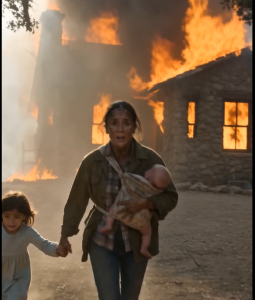
The forest seemed to move around them. Tall trees stood like dark witnesses on every side, their trunks streaked with smoke, their branches trembling in the hot wind pushing out from the flames. Dirt kicked up beneath the mother’s shoes. Roots curled across the path like traps. Every few feet, she looked over her shoulder, not because she wanted to see the fire, but because she needed to know how close it was. The roar behind them was no ordinary sound. It was alive, hungry, and growing.
Her daughter ran barefoot beside her, wearing the light dress she had been in when everything changed. There had been no time for shoes. No time to gather bags. No time to search for anything that could be replaced. The only things that mattered were the two children with her now, one running, one carried, both depending on her to keep moving no matter how badly her legs burned.
The little girl’s feet struck the dirt again and again, landing between exposed roots and broken twigs. Each step looked too small for the danger chasing them. Her toes were dusty, and the rough ground offered no mercy, but she did not let go of her mother’s hand. She stumbled once, just enough for fear to flash across the mother’s face, but the woman pulled her gently forward, steadying her without stopping. The child found her balance and kept running.
There were no words between them at first. Words would have wasted breath, and breath was too precious. The fire roared. Their footsteps slapped against dirt and wood. The baby made a small sound against the mother’s chest, muffled by the blanket and the pounding of the mother’s heart. The mother lowered one arm around the infant, shielding the tiny body as best she could while still holding tight to her daughter.
Her face was streaked with dirt and ash. Her dark hair, tied up in a hurried knot, had loosened in the rush, and strands clung to her damp forehead. She wore a jacket over a flannel shirt and jeans, clothes meant for an ordinary day outdoors, not for running from disaster. Yet in that moment, nothing about her looked ordinary. Fear was in her eyes, yes, but so was something stronger. She was terrified, but she was not helpless. She was a mother, and every choice inside her had narrowed to one purpose: get the children away from the flames.
They pushed through a wider clearing where the smoke thinned just enough for the trees ahead to come into view. The mother turned her head quickly, scanning left, then right, searching for open ground, for a safer path, for anything that might lead them farther from the burning structure. Behind them, the cabin threw another burst of orange light across the woods, and for one awful second the clearing lit up as if the sun had fallen behind them.
The mother tightened her grip. The girl’s small hand was warm and frightened inside hers. She could feel the child trying to keep pace, hear the quick breaths, sense the silent question in every stumbling step: Are we going to make it? The mother did not answer out loud. She answered by running faster.
The baby carrier bounced against her chest. She kept one palm pressed protectively over the blanket, feeling for movement, feeling for life, feeling for the tiny proof that her youngest child was still safe in her arms. Every muscle in her body begged for rest, but rest belonged to another life, the life that had existed before the fire, before smoke filled the air, before the cabin became something they had to escape instead of something that held them.
At the edge of the clearing, the ground dipped slightly, and the mother adjusted her stride. She guided her daughter around a thick root and past a patch of loose dirt that might have sent the child falling. Her attention split in every direction at once: the fire behind them, the baby against her chest, the girl beside her, the trees ahead, the sound of their breathing, the possibility that the flames could spread faster than they could run.
Then, through the pounding noise of panic and survival, her own voice rose in her mind, calm and broken at the same time. Our life will never be the same.
It was not a dramatic thought. It was the simple truth arriving with the smoke. Even if they reached safety, even if the fire stayed behind them, even if the night ended with all three of them alive, something had already changed. A home could be rebuilt. Clothing could be replaced. A burned wall could become lumber and labor and time. But the feeling of running through the woods with one child in her arms and another in her hand would never leave her.
She knew her daughter would remember pieces of it: the heat at her back, the dirt under her bare feet, the sound of her mother breathing hard but never letting go. The baby might never remember the fire, but the mother would remember enough for all of them. She would remember the weight against her chest, the way the blanket smelled faintly of smoke, and the fierce promise she made without speaking it: nothing would take them from her if she could still stand.
The woods stretched ahead, uncertain and shadowed, but they were moving away from the blaze. That was all she could ask of the moment. One step, then another. One breath, then another. The young girl stayed beside her. The infant stayed close to her heart. And behind them, the fire continued to rage, loud enough to shake the air, bright enough to stain the trees, cruel enough to mark the beginning of a new life none of them had chosen.
Still, the mother ran. She ran through smoke and fear, through roots and dirt, through the terrible knowledge that everything familiar might already be gone. She ran because love had become motion. She ran because courage was not the absence of fear, but the refusal to let fear decide who survived. And as the flames burned behind her and the forest opened ahead, she held both children close in the only way she could, carrying one, guiding the other, and stepping into a future that would have to be built from the ashes. What waited beyond the trees was uncertain, but the reason to keep going was clear in every heartbeat: her children were alive, and that was the hope she would follow home.