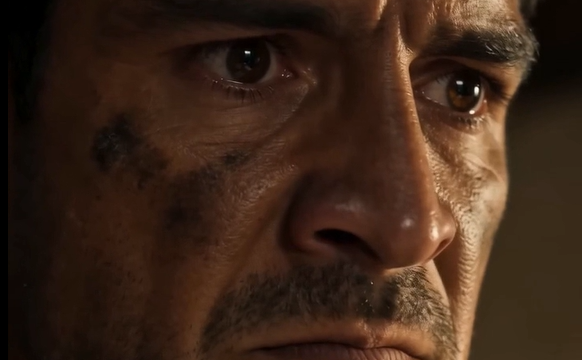
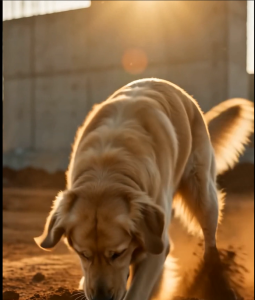
The Georgia heat was brutal at two, baking the red clay around my unfinished house, but nothing compared to my anger when I saw that scruffy golden mutt tearing up my foundation again.
“Get away from there!”
He was digging beside the master bedroom wall, clay flying. When I shouted, he whined but did not run. He stood over the hole, shaking, one torn ear flattened.
Divorce papers, construction bills, and my silent son had worn me thin. When the dog refused to move, something snapped. I drew my leg back.
The dog squeezed his eyes shut.
Then sunlight flashed from dirt. I stopped, and the dog tapped the hole.
I knelt and scraped away clay. Buried a foot deep was a rusted Star Wars lunchbox. On top lay a locket I knew instantly.
My father’s locket.
Robert Miller swore he lost it in a poker game in 1995. He died ten years ago in Seattle. He hated Georgia and had never been here.
Inside was a water-damaged photo of Dad and me beside his blue Ford truck and a plastic-wrapped letter.
“My dearest Martha,” it began.
My mother’s name was Susan.
The letter, dated July 14, 1995, was in Dad’s handwriting. He was leaving Martha, his mistress, to protect me, his fifteen-year-old son. He was choosing the lie, burying the box where they had planned a porch, and leaving the deed in her name. Beneath it were a loaded .38 and a ring.
I looked at the dog. “You knew this was here.”
His tail thumped once.
At Earl’s Hardware, Earl froze when I mentioned Martha.
“Folks don’t talk about the Holloway place,” he said. “Martha was a sweet waitress. In ’95, she met a big-shot architect who promised her a castle. Then she vanished. Car in the driveway, purse inside, no note, no body. Talk to Janice, her sister, at the florist.”
Janice gasped when I showed her the locket. “That was our mother’s. Martha wore it every day.” She saw the picture and went pale.
“He buried it under my foundation,” I said.
“Martha would never bury this.” She looked at the dog. “Martha had a golden retriever named Barnaby. He disappeared the same day. Look at his left ear.”
The ragged tear was old and ugly.
“Barnaby tore his the same way on a fence.”
“That dog is only four,” I said.
“Maybe,” she whispered. “Or maybe blood remembers.” Her voice dropped. “Martha was pregnant when she disappeared. With his child. Your sibling.”
Back at the property, the dog growled at the woods. I followed him to a kudzu-choked clearing. Under the vines sat a rusted blue Ford with 1995 Georgia plates. On the seat lay a baby rattle. Underneath were bones.
I called 911.
Sheriff Brody arrived. “A stray dog led you to a thirty-year-old murder?”
“I was fifteen in Seattle,” I said.
He held up an evidence bag. “This .38 was registered to Robert Jackson Miller. Purchased June 1995. Two rounds fired. Skull shows trauma.”
A deputy found a planner. July 14th read, “Meeting with R.M. — The Ridge, 2:00 PM.” In shaky handwriting: “He knows. He’s coming to take it.”
Brody showed me a silver baby rattle engraved J.M.
“Why would she have my initials?” I asked.
“Maybe for the baby. Named after his father or brother.”
“The baby died too?”
Brody’s face softened. “No fetal remains. She gave birth hours, maybe days before she was killed. Someone took the newborn.”
At three that morning in the Oakhaven Motel, I pried the photo from the locket. On back was “Atlanta Clinic — June 20” and a number. An elderly woman answered.
“I found this number on a photo belonging to Robert Miller.”
She gasped. “Robert is dead.”
“I’m his son. Jackson.”
“You have his voice,” she whispered. “I’m Eleanor. I was a nurse where Martha gave birth.”
“Where is the baby?”
“Robert took him. Martha was terrified of her.”
“Her?”
“Your mother. Susan. She came from old money. When she found out, she threatened Robert and the child. Robert paid me to falsify records and say the baby was stillborn. He took the boy to hide him. Robert was a coward, not a killer. Your mother had ways.”
The line went dead.
Outside, a black sedan idled. Its headlights flashed, then it accelerated at me. I grabbed the dog and threw us back as the car smashed into the motel wall, reversed, and sped away.
On the ground was a white envelope. Inside was a Polaroid of a baby in a blue blanket, held by younger Earl. On the back: LET SLEEPING DOGS LIE.
I drove to Earl’s house. He met me with a shotgun, then lowered it. “Figured you’d come.”
In his kitchen, I slapped down the photo. “Tell me about my brother.”
Earl’s hands shook. “Your daddy gave me the baby. Fifty thousand cash. Said, ‘Hide him. Raise him. If Susan finds out, she’ll kill him.’ He was supposed to meet Martha July 14th. She never made it. He waited two days, buried the box, and went home broken.”
“Who drove the car tonight?”
Earl went pale. “Brody. He was a deputy in ’95. Took the report and told everyone Martha ran off. Your mother hired him.”
“Where is the boy?”
Tears filled Earl’s eyes. “Closer than you think. It’s Clay. Deputy Clay. I raised him.”
The kitchen window shattered. Earl jerked back, blood on his shoulder. I flipped the table as another shot hit the fridge.
The dog bolted out back. I followed and found Brody trying to shake seventy pounds of furious dog from his rifle arm. I slammed a tire iron into his ribs. He dropped the gun.
“Why?” I demanded.
“Your mother paid better than the county,” Brody spat. “I was supposed to take the baby too, but Martha would not tell me where he was. She died protecting him.”
Sirens wailed. Deputy Clay jumped out, weapon drawn. “Step away!”
“Clay!” Brody screamed. “He shot Earl!”
I dropped the tire iron. “Check the rifle. Then ask why Earl has your baby picture.”
The dog trotted to Clay and whined. Clay stared at Brody, then ran to Earl.
Six months later, I sat on my finished porch throwing a tennis ball for Scout. Clay pulled up. Brody had taken life without parole after exposing my mother’s wire transfers. Earl had survived.
Clay sat beside me and held out the locket. “Earl said it belongs to family.”
I pushed it back. “Dad left it for Martha. For you.”
Clay closed his fingers around it. “Thanks, brother.”
Scout barked, and Clay threw the ball. We watched him run, golden and free. I thought about Dad’s weakness, secrets, and buried love. I thought about my mother, the monster behind a respectable face. Looking at Clay, I knew we are not our parents. We are the choices we make after the dirt is cleared.
“I’m thinking of building a guest house out back,” I said. “Could use another pair of hands.”
Clay smiled. “I’m pretty good with a hammer.”
“Good,” I said. “Welcome home.”
Scout dropped the ball at our feet, amber eyes bright. The ghosts were resting. The living had been found. And the house was quiet, not with emptiness, but with peace.