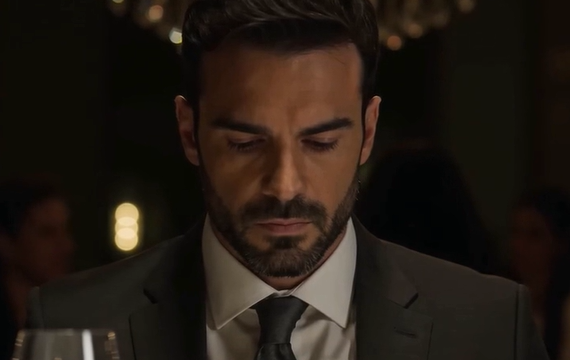
He could read balance sheets, legal threats, market shifts, and boardroom silence but he no longer allowed himself to study another person’s eyes for more than a second. Looking too closely had once cost him something he never learned how to name. So he stopped. He built walls out of schedules, assistants, private elevators, and a life so polished it left no space for questions.
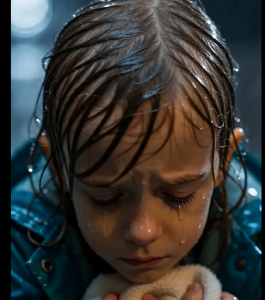
At 9:47, he stepped through the revolving doors of the Meridian Grand Hotel, two minutes behind schedule. His driver waited at the curb beside a dark sedan, umbrella raised, door ready. Between Viktor and the car sat a child.
She looked no older than nine, perhaps ten. A thin coat clung to her small frame, and a worn cloth bag rested on her lap. Her shoes had been repaired with duct tape, wrapped around the toes as if someone had tried to hold them together another day. She sat on the marble step like she belonged there more than anyone inside.
Viktor’s first instinct was to pass her. He had mastered that art long ago. Thirty years of building an empire had taught him which interruptions deserved attention and which should be left behind. A man with towers and contracts could not stop for every sad figure on a wet sidewalk.
But he did not move. The girl was humming.
It was not the careless sound of a bored child or a tune from a commercial. The melody was precise, delicate, and painfully familiar. Chopin. Nocturne in E-flat major, Op. 9, No. 2. She carried the phrase with the patience of someone who had learned that beauty could survive where comfort did not.
“Where did you learn that?” Viktor asked.
The question surprised him. He had not meant to speak. His voice sounded colder than he intended.
The girl lifted her face. Her eyes were calm, almost too calm. They did not plead or widen with fear. They carried the watchfulness of a child who had discovered early that panic wasted energy.
“I’m listening,” she said softly.
Viktor frowned. “Listening to what?”
She tilted her head toward the glass lobby doors behind him. “The piano.”
For the first time that night, Viktor heard it. A pianist was playing for a half-empty lobby. The notes floated past polished floors and guests too busy with phones to notice. Viktor had crossed that lobby minutes earlier without registering a single measure. He rarely noticed anything that did not involve numbers, signatures, or risk.
The girl looked toward the warm light beyond the doors. “It sounds like it’s sad,” she said, “but trying not to be.”
The words slipped under Viktor’s defenses with an accuracy that made him uneasy. He looked back at her, truly looked, and he did not turn away.
“And why does that matter to you?” he asked.
The girl hesitated. Her fingers tightened around the cloth bag. Then she reached inside and pulled out a folded photograph. She did not offer it to him. She held it against her chest, not like a child showing off a treasure, but like someone protecting the last piece of a life that had nearly vanished.
“My mother liked that song,” she said.
Rain tapped against the hotel awning. The driver waited to open the door. Viktor ignored him.
“Where is your mother?” he asked, though he feared the answer.
The girl looked down at the photograph. “Gone.”
There was no drama in the word. No performance. Just a small fact, spoken by someone who had repeated it often enough that the sound no longer broke apart.
Viktor should have nodded and continued to the car. Men like him had staff for charitable decisions. Foundations handled grief in organized columns. But the melody was still coming from inside, and the girl was still holding that photograph, and her sentence had opened a door he thought he had sealed forever.
“What’s your name?” he asked.
“Lena.”
“Lena what?”
She hesitated. “Lena Marlow.”
The name struck him with such force that the hotel lights seemed to tilt.
Marlow.
His jaw tightened. He had known only one Marlow who loved Chopin like a private language. Elena Marlow had played that nocturne in the south music room of his old estate. She had played it during storms. She had played it the night Viktor chose a merger over a conversation, a signature over a promise, and a future that looked impressive from the outside but hollow within.
He stared at the child’s folded photograph. “May I see it?”
Lena drew back a little, enough to remind him that she had learned to measure adults carefully.
Viktor lowered himself one step, though his coat brushed the rain-wet marble. Viktor Hale did not kneel on sidewalks or make himself smaller for anyone.
“I won’t take it,” he said.
After a moment, Lena unfolded the photograph and turned it toward him.
The image had faded at the edges. A young woman stood beside a piano, smiling with one hand resting lightly on the keys. Her hair was dark, her eyes bright, her face unmistakable. Viktor felt the air leave his lungs.
Elena.
Beside her stood a younger Viktor Hale, before the sharp lines, before the guarded stare, before wealth had taught him to look untouchable. On the back, written in blue ink, was a date from more than a decade earlier and a short message: For the night you finally listened.
Viktor could not speak. Lena watched him carefully. “You know her?”
“Yes,” he said at last. “I knew her.”
The child’s eyes searched his face. “She said a man once promised he would come back when the music ended.”
Viktor closed his eyes.
Eleven years of silence collapsed into one sentence. He remembered the last argument, the phone call he ignored, the letter he never opened because pride was easier than pain. He remembered telling himself that successful men did not chase what had already walked away. He remembered how quickly regret hardened into routine.
When he opened his eyes, Lena was still there, holding the photograph that had crossed a decade and found him in the rain.
Viktor looked toward the lobby. The pianist had reached the final phrases of the nocturne. The song did sound sad. And it did sound as if it were trying not to be.
“Lena,” he said quietly, “why are you here?”
She folded the photograph with care. “Because my mother told me if I ever had nowhere else to go, I should find the hotel with the piano and listen. She said someone there might remember.”
Viktor’s face changed. Not dramatically. But something inside the polished, distant billionaire gave way.
For eleven years, he had trained himself not to look at people because looking meant remembering. Now a child with taped shoes and her mother’s song had forced him to see everything.
He stood and turned to his driver. “Cancel the car.”
The driver blinked. “Sir?”
“Cancel it.”
Then Viktor looked back at Lena and held out his hand, not as a command, not as charity, but as a promise he was terrified to make and more terrified to break.
“Come inside,” he said. “I think it’s time I listened.”
Word count: 1199 words.