I keep my boots on the top shelf in the garage, behind the paint cans where I do not have to see them. They are ordinary winter boots, but when I see them, my stomach turns. Some objects do not only remind you of what happened. They remind you of who you were in the worst second of your life.
Anyone who has loved a dog understands the routine. Dogs bark at squirrels, delivery trucks, strangers, loose leaves, and sometimes nothing at all. You learn their language: the treat whine, the stranger rumble, and dream sounds.
Buster was a Golden Retriever mix, six years old, with bad hips and a heart too gentle for this world. His aggression level was somewhere between a pillow and a marshmallow. In all our years together, I had heard him truly growl only twice. He loved everyone.
He was the best boy. That is why I should have listened.
It was February in Minnesota, the kind of night when the cold feels personal. The temperature had dropped to twenty below, and the wind made the air dangerous. My wife, Sarah, was asleep upstairs after another brutal double shift in the emergency room. I was on the couch at three in the morning, watching reruns I could barely follow.
Then Buster started.
It was not his normal bark. First came a low whine, thin and tense. Then scratching at the back door. Then a deep, steady bark from his chest, shaking the laundry room walls.
“Buster, quiet,” I hissed, hoping Sarah would not wake up.
He did not stop. He threw his body against the back door hard enough to rattle the glass panes. I told myself he had spotted a raccoon or heard the wind pulling at the fence. But the barking grew sharper.
I stumbled into the laundry room barefoot and furious. When I flipped on the light, Buster’s hackles stood straight up. His tail was low and stiff. His ears were pinned back. He was not excited. He was terrified.
“It’s twenty below,” I muttered, grabbing his collar. “You are not going out.”
Buster twisted in my grip, looked me in the eyes, and made a sound I had never heard from him, or from any dog. It was half howl, half scream, raw and ancient, like a warning deeper than training.
Then he lunged at the door again, clawing the wooden frame and tearing paint from the edge.
“Fine,” I snapped. “Go freeze.”
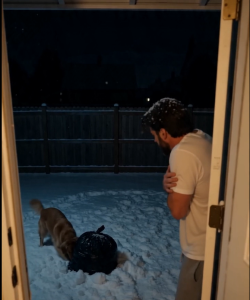
I opened the door, and the wind struck me across the face like a slap. Buster exploded into the yard. He did not head for his usual spot by the fence. He ran straight to the far corner near the alley trash cans, where garbage bags sat under hard snow. He tore into them, biting, digging, shredding plastic like something depended on it.
“Buster! Leave it!”
He ignored me.
I was tired, cold, and angry in the selfish way people get when pulled from sleep. My head was pounding. The snow was blowing sideways. I shoved on my heavy boots and stomped through knee-deep snow toward him.
When I reached him, I did not stop to understand.
I kicked him.
Hard. Right in the ribs.
“Get away from there!” I shouted.
Buster yelped, cracking something inside me before I understood why. He tumbled sideways into the snow, struggling for breath. I pointed toward the house and yelled again.
“Inside. Now.”
Most dogs would have cowered, lowering their heads and slinking away, confused by the person they trusted most. Buster stood his ground. He staggered up, shook snow from his coat, and growled at me. My own dog, the gentle marshmallow who had never wanted to hurt anything, bared his teeth as if I were the danger.
Before I could reach for his collar, he threw himself back at the garbage pile. He clamped his jaws onto something heavy and pulled, bracing his weak back legs, shaking his head with all his strength. Whatever he had found was not an empty bag.
One final tug, and it slid free across the snow.
A dirty pink fleece blanket.
It was stiff with ice.
“It’s just a rag,” I said, though my voice had lost its anger. “Come on. Let’s go.”
I turned toward the house, expecting him to follow. He did not. The barking had stopped. The growling was gone. Buster lowered his head and began licking the frozen blanket, whining softly. He nudged it with his nose, carefully, almost tenderly.
That tenderness is what made me turn back.
I knelt in the snow and pulled at the edge of the blanket. At first it resisted. Then it opened enough for me to see a tiny gray hand. For a moment, my mind refused to accept it. Then the blanket shifted, barely, and a sound came out so faint it could have been the wind.
A baby.
There was a baby in the trash.
Everything inside me changed at once. The cold, anger, and exhaustion vanished. I tore the blanket open with shaking hands. A newborn girl lay inside, her skin pale, her lips bluish, her cries weak and broken. She was wrapped in the pink fleece and tucked inside a garbage bag that Buster had shredded open with his teeth.
I screamed for Sarah.
I do not remember getting back to the house. I remember Buster limping beside me, blood from his mouth where the plastic had cut his gums. I remember Sarah racing down the stairs, instantly awake the way nurses are when life is on the line. She wrapped the baby in warm towels, checked her breathing, called 911, and gave instructions while tears ran down her face.
The ambulance came fast, though it felt like years. The paramedics took the baby, and one of them looked down at Buster, lying on the floor beside the towels, panting in pain.
“That dog saved her life,” he said.
She lived. That is the part I hold onto when the guilt gets heavy. The doctors said another few minutes in that cold might have been too late. They named her Grace at the hospital until relatives could be found. I never learned all the details. What mattered was that a helpless life had been buried in the snow, and my dog knew.
My dog knew, and I almost stopped him.
For weeks, I could not forgive myself. Buster had bruised ribs, nothing broken, thank God, but he moved slowly. Every time he limped, I saw my boot swinging through the dark. I apologized over and over, sitting on the kitchen floor with my hand on his head. He leaned into me, forgiving me faster than I deserved.
That may be the hardest lesson dogs teach us. They love with a patience we rarely earn.
I keep those boots out of sight because I never want to forget what anger can do in one careless second. I also keep them because they remind me to listen when a gentle soul refuses to back down. Sometimes what looks like disobedience is courage. Sometimes the one making noise is the only one paying attention. Sometimes the best boy in the world is trying to save a life while we are too tired, too proud, or too irritated to see it.