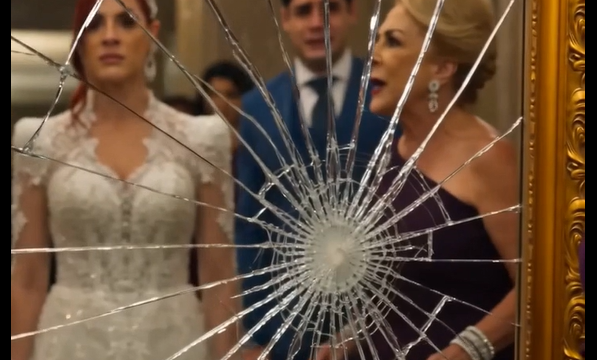
The groom looked like the ground beneath him had suddenly disappeared. His face drained of color as every eye in the church turned toward him. For a second, nobody spoke. The soft music had stopped, the guests sat frozen in silence, and even the priest seemed unsure whether the ceremony was still happening.
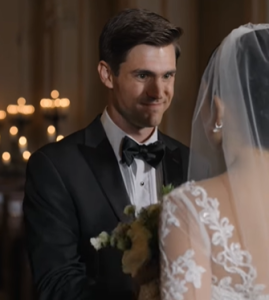
“I didn’t forge anything,” the groom said quickly.
That was the first thing that gave him away.
Not the words themselves.
The speed.
The panic hidden behind them.
It was the kind of reaction that came from fear instead of innocence.
The bride’s father stood near the altar holding a single sheet of paper between two fingers. His expression was calm, cold, and unreadable. He looked like a man who had spent years sitting across from dishonest people in corporate boardrooms and knew exactly when someone was lying.
“This,” he said quietly, raising the document slightly, “is a transfer authorization.”
The bride blinked through tears. Her makeup was already beginning to smear from the emotional chaos unfolding around her. “Transfer of what?” she whispered.
Without answering immediately, her father turned the paper toward her so she could see it clearly.
At the top was her name.
Below it was a signature that looked almost identical to hers.
Almost.
Her breathing became uneven as her hands started trembling harder. She stared at the signature again, searching for some explanation that would make sense.
“I never signed that,” she said.
“I know,” her father replied.
The groom immediately stepped forward, trying to regain control of the situation. His polished charm returned in a rush, but now it felt desperate instead of confident.
“This is all a misunderstanding,” he insisted. “She gave me permission to handle some paperwork for the wedding and our future finances—”
The bride’s father silenced him with a single glance.
“No,” he said sharply. “She gave you trust.”
The sentence hit harder than yelling ever could.
A murmur moved through the church pews. Guests exchanged nervous looks while some lowered their heads awkwardly, suddenly realizing they were witnessing something far darker than a wedding argument.
The bride felt her stomach twist. The room no longer felt steady around her.
“What was he transferring?” she asked softly.
Her father never took his eyes off the groom.
“Your shares.”
Silence crashed over the church once again.
Not the silence of surprise anymore.
The silence of understanding.
This was no longer simply about betrayal at the altar. It was about money, control, and a carefully planned deception.
For months, the groom had been pressuring her to sign documents she barely understood. Every time she questioned something, he brushed it off casually.
Business formalities.
Temporary permissions.
Routine paperwork.
He always acted offended whenever she hesitated, making her feel guilty for not trusting him completely. Still, something deep inside her had never allowed her to fully agree.
She had refused several times.
Now she finally understood why his behavior had become increasingly impatient as the wedding approached.
He had adjusted his strategy.
If she would not sign willingly before the marriage, he planned to marry her first, gain easier legal access afterward, and move the shares quietly once everything was official.
But he had failed to hide the fraud long enough.
The groom’s polished mask finally began to crack. His jaw tightened as frustration replaced panic.
“You don’t understand how much I’ve invested in this,” he snapped angrily.
The bride stared at him in disbelief.
Invested.
That was the word he chose.
Not loved.
Not cared for.
Not built a future with.
Invested.
In that moment, the truth hurt more than the public humiliation ever could.
Her father gave a small humorless smile.
“Oh, I understand perfectly,” he said. “You approached my daughter under a false identity. You hid your debt, gained access to confidential financial planning documents, and positioned yourself to take control the moment marriage made it legally easier.”
Gasps spread across the church.
Several guests looked openly horrified now. Others stared at the groom as though they no longer recognized the man they had been celebrating only minutes earlier.
The groom looked around wildly, almost searching for someone willing to defend him.
Nobody moved.
Nobody spoke.
The bride slowly wiped tears from her face with the back of her trembling hand. Her heartbreak was beginning to transform into something colder and clearer.
Finally, she asked the question that mattered most.
“How long?” she whispered.
The groom said nothing.
But his silence answered everything.
Her father spoke instead.
“Long enough,” he said quietly, “that he never realized the woman he called poor was already the largest private shareholder in my company.”
The groom went completely pale.
The realization struck him all at once.
Every assumption he had made about her had been wrong from the beginning.
Her simple clothing.
Her modest apartment.
Her quiet lifestyle.
Her refusal to show off wealth.
He had mistaken privacy for weakness.
And now that mistake was destroying him in front of everyone.
The bride remembered every cruel little comment he had made during their relationship. Every subtle insult disguised as concern. Every moment he acted superior because he believed she needed him more than he needed her.
But none of it had ever been true.
He never loved the woman standing beside him.
He loved the opportunity he thought she represented.
Her father calmly folded the forged document once and slipped it into his coat pocket.
“You will not be returning to the office,” he said firmly.
Then, after a brief pause, he added in an even quieter tone:
“And you should probably contact an attorney before the police arrive.”
The groom looked like he could barely breathe.
The bride closed her eyes for a moment.
Not because she was weak.
Because she finally felt free.
When she opened them again, tears still remained in her eyes, but something inside her had changed. The pain was still there, yet the confusion was gone.
Now she understood everything.
He had never rejected her because she was not good enough.
He had chosen her because he believed she would be easy to manipulate.
Her father gently extended his hand toward her.
“Come on,” he said softly. “Let’s get you out of here.”
She nodded and took one step toward him.
But before they could walk away, the groom suddenly spoke again in a broken voice.
“Wait…”
Both of them stopped.
His terrified eyes moved from the father back to the bride.
“If she’s your daughter…” he said slowly, panic turning into horror, “…then who have I really been reporting to for the last six months?”
For the first time since the chaos began, the bride’s expression became completely calm.
Her father stayed silent.
She answered for him.
And for the first time in the entire church, her voice did not shake.
“You,” she said steadily, “have been sending every confidential update directly to the company’s new executive director.”
She paused briefly while the truth settled over the room.
Then she looked him directly in the eyes.
“That’s me.”