Candles still flickered across the white tablecloths while untouched champagne glasses reflected the golden light above the restaurant. Near the wall, the violinist stood frozen with his bow lowered. Guests who moments earlier had lifted their phones to record the humiliation now held them motionless. The missing diamond ring no longer mattered. Every eye had shifted toward the sealed letter resting on the marble floor, and suddenly the elegant restaurant no longer looked glamorous. It looked poisoned by old secrets.
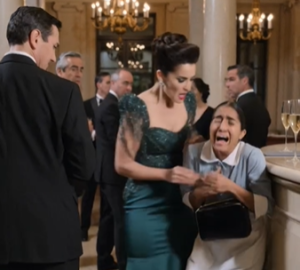
At the center of the dining room stood the young hostess, trembling so badly she could barely breathe. Her sleeve had been ripped open during the public search, and tears continued running down her face. Humiliation still covered her expression, but now another emotion sat beside it: fear. Not fear of losing her job. Fear of recognition.
The letter had belonged to her mother for years. Hidden inside coat linings and carefully moved from place to place, it had always been protected like something dangerous. As a child, the hostess believed it was only an old love letter. Later she realized her mother was not hiding the note from strangers. She was hiding it from a wealthy family.
The older man holding the letter explained what had happened more than twenty years earlier. His younger brother had once been engaged to a beautiful woman from a poor background, someone their powerful family never accepted. The engagement dinner had taken place in that same restaurant. It was supposed to end with champagne and a diamond ring. Instead, before midnight, the bride-to-be disappeared.
Society was told a simple story. She had become emotional and overwhelmed by pressure. No investigation followed. Within a year, the younger brother married another woman.
The same woman now standing in the middle of the dining room wearing dark red couture.
The older man asked who had given the hostess the letter. When she answered, “My mother,” he asked for her mother’s name. The moment she spoke it aloud, his face changed completely. He recognized it immediately. According to him, the woman had once been the vanished fiancée’s dressmaker and closest companion, the last person seen entering a private room with her before she disappeared forever.
Afterward, the companion vanished too.
Staff members had been told she stole money and ran away. Wealthy friends whispered she knew dangerous things.
The hostess explained that her mother never called herself a victim. Instead, she warned her daughter that rich families do not always bury the truth with violence. Sometimes they bury it with marriage licenses, money, and silence. They moved constantly from city to city while her mother survived through cleaning jobs and sewing work.
Yet every year on the same date, her mother removed the sealed note, stared at the handwriting, and repeated the same instruction.
“If his new wife ever humiliates you in public, open it.”
That sentence spread through the dining room like ice water.
The horrifying part was not simply that the letter existed. It was that the condition had always depended on accusation.
The woman in red had unknowingly activated the warning the hostess’s mother had waited decades to use.
The older man admitted he recognized his brother’s handwriting immediately. On the night the fiancée disappeared, his brother vanished from the dining room for nearly twenty minutes before returning furious and pale. By sunrise, the engagement had officially collapsed and the family’s version of events replaced the truth.
“If this letter came from that night,” the older man whispered, “then my brother wrote something privately he was too afraid to admit publicly.”
The woman in red finally broke her silence.
“This is ridiculous,” she snapped too quickly. “An old note appears and suddenly everyone wants to invent a tragedy.”
But beneath her words, the guests could hear panic.
The older man asked the question nobody else dared to speak aloud. If the note meant nothing, why had the hostess’s mother instructed her daughter to open it only if the new wife publicly accused her?
The answer arrived before anyone said it aloud.
Because accusation reveals recognition.
If the woman in red reacted instantly with cruelty, then she was not responding to theft. She was responding to memory.
Quietly, she admitted her mother once hinted that the vanished fiancée had not been alone that night. There had been “something else to protect.” Her mother often repeated one mysterious question.
“Don’t ask who left. Ask who was removed.”
The letter was never about romance.
It was about bloodline.
With shaking hands, the older man finally broke the seal.
Inside rested a single yellowed page folded neatly with age. As he read, his expression slowly collapsed into shame.
The first sentence read: “If this letter ever reaches the child, then her mother was right not to trust my family.”
The hostess covered her mouth as tears filled her eyes again.
The older man continued reading. His brother confessed that the woman later labeled unstable had discovered a terrible truth before the engagement dinner ended. He planned to marry her publicly while secretly maintaining another arrangement, one protected by the very woman who eventually became his wife. There had been threats and fear surrounding a child whose existence complicated inheritance and reputation.
The fiancée did not run away from love.
She tried to save her daughter from it.
Then the older man read the final lines aloud.
“If they claim her mother abandoned her, they are lying. If they say no child existed, they are lying again. And if my future wife ever accuses the girl publicly, it means she recognized her before anyone else did.”
That sentence shattered the evening completely.
The hostess no longer needed proof that the letter belonged to her. The letter had recognized her long before she understood herself.
The older man slowly lowered the page and revealed the truth nobody in the restaurant was prepared to hear.
She was the hidden daughter whose existence once threatened a marriage, a fortune, and a lie powerful enough to survive for decades.
Every person in the restaurant turned toward the woman in red.
She had never truly believed the hostess stole the diamond ring. Her accusation had come from panic.
Finally, the hostess looked directly at the woman in red.
“You never thought I stole your ring,” she said quietly.
Then her eyes shifted toward the opened letter.
“You recognized the woman your marriage replaced before I ever knew I was her daughter.”